Bastia
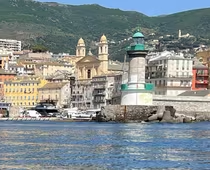
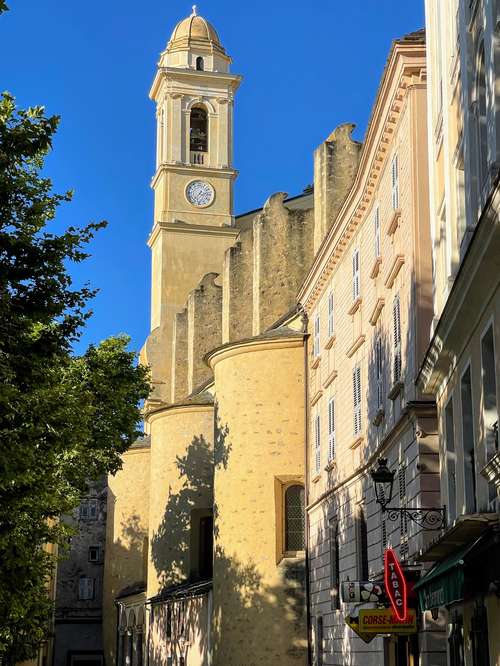
Bastia is the second-largest city on the Mediterranean island of Corsica, and one of the main points of arrival on the island, either by plane or via one of the Ferries.
Location
Bastia, Corsica, France

The city of Bastia is located on the northeast part of the island of Corsica, at the base of Cap Corse and opposite to the city of Saint-Florent. Bastia is the principal port of the island and also the principal commercial town.

© Copyrigh 2026 Laki Maikaʻi. All rights reserved.
History
The island of Corsica formed about 250 million years ago by the convergence between the Iberian, European, and African tectonic plates. It is the most mountainous island in the Mediterranean and is described as a "mountain in the sea".
Corsica has been occupied continuously since the Mesolithic era. Its population was influential in the Mediterranean during its long history.
After a brief occupation by the Carthaginians, the island was occupied by the ancient Greeks. The origin of the name Corsica is still unclear. To the Ancient Greeks, it was known as Kalliste, Corsis, Cyrnos, Cernealis, or Cirné. The last three variations derive from the most ancient Greek name of the island, "Σειρηνούσσαι" ("Seirenoussai", meaning of the Sirens) — the very same Sirens mentioned in Homer's Odyssey.
Later, after being occupied by the Etruscans, the island was incorporated into the Roman Republic in 238 BC. The Romans built a colony in Aléria and considered Corsica as one of the most unruly regions of the Roman world. The island produced sheep, honey, resin, and wax, and exported many slaves, not well considered because of their fierce and rebellious character.
In Roman times, the city of Bastia did not exist. On the coast, there was a small settlement populated by fishermen called Porto Cardo, which means "Cardo harbor". This site is part of the north-eastern district of the current commune of Bastia.
In the 5th century, the western half of the Roman Empire collapsed, and the island was invaded by the Vandals, the Ostrogoths, and the Byzantines before becoming part of the Kingdom of the Lombards. After that, the island came under the influence of the republic of Pisa until their defeat in 1284 at the Battle of Meloria against Genoa.
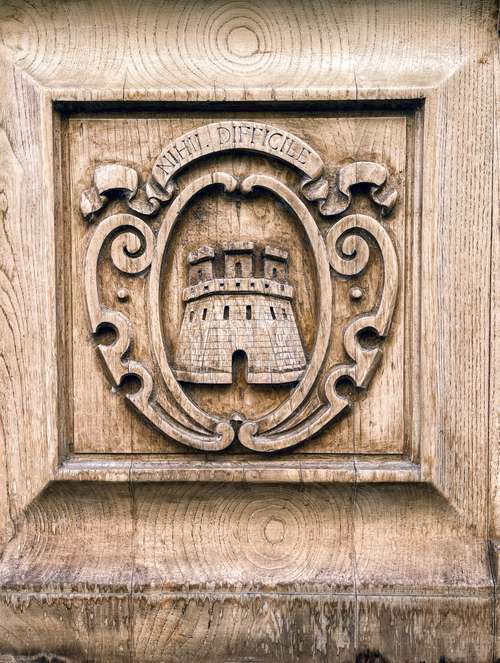
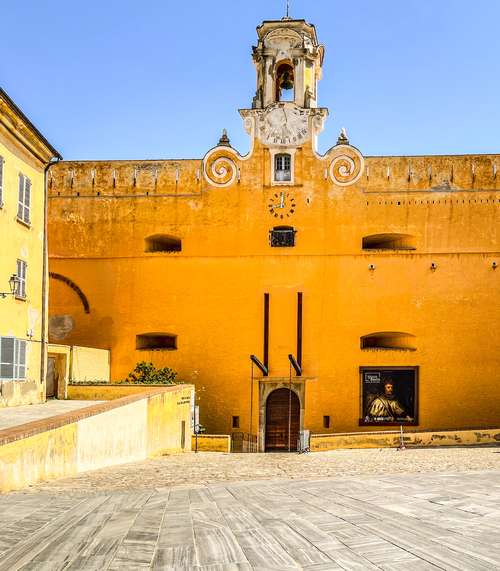
The Genoese soon felt the need to protect Bastia from invasions coming from the sea and began to build a Bastiglia (bastille or citadel) in 1353. The city originated on the rock where the tower was built and, a hundred years later, was surrounded by walls. Bastia was the capital at the time of the Genoese domination and gradually became prosperous and more important than Cardo. It spread towards the plain later, drawn toward the water in the Place Saint-Nicolas.
In 1584 the Governor of Genoa imposed that all farmers and landowners in Corsica must plant four trees yearly: a chestnut, olive, fig and a mulberry tree. This decision allowed many villages owe their origin and their former richness to the chestnut-woods.
The economy, and with the economy the political, cultural and social life of the Castagniccia, the most important chestnut-area, began to flourish from the 16th century on. The period of peace lasted until 1729 when the refusal to pay taxes by a peasant sparked the general insurrection of the island against Genoa and the beginning of the Corsican Revolution for independence followed by the beginning of the French influence on the island. Shortly after the French Revolution in 1794, British forces briefly occupied the island before returning it to France in 1796.
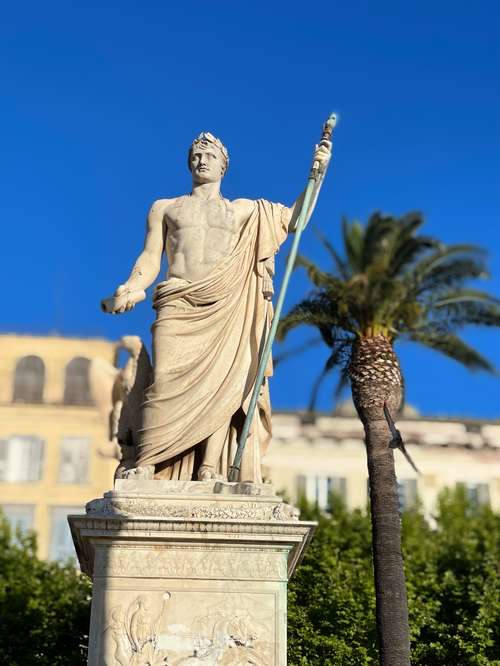
Despite being the birthplace of Emperor Napoléon Bonaparte, the island was neglected by Napoleon's government.
Corsica paid a high price during the First World War. Several years of absence by the majority of young workers severely disrupted agriculture, and the percentage of dead or wounded Corsicans in the conflict was double that of those from mainland France.
During World War II, the island was occupied by German and Italian forces as part of Benito Mussolini's reunification policy of Italy. Bastia suffered much damage at the hand of American bombers, but Corsica became the first French department to be liberated on 4 October 1943, with help from commandos debarked from submarine Casabianca (the turret of the submarine is displayed on the corner of Place Saint-Nicolas, towards the sea). The US military then established 14 airfields on the flat eastern shore nicknamed "USS Corsica", an unsinkable aircraft carrier that served as bases for attacks on targets in German-occupied Italy, southern France, and Austria.
After the war, Bastia gradually reestablished itself and grew into a key economic center of Corsica. Its strategic location on the northeastern coast, with a natural deep-water port, allowed it to become a hub for maritime trade, fishing, and commerce.
Over the decades, Bastia attracted businesses, government services, and cultural institutions, solidifying its role as a focal point for the island’s economy. Today, the Bastia agglomeration is the most extensive urban area on Corsica, encompassing not only the city itself but also surrounding communes, and serving as a central node for transportation, industry, and tourism. Its urban and economic growth reflects both its historical importance and its continuing role as a gateway between Corsica and mainland France.

© Copyrigh 2026 Laki Maikaʻi. All rights reserved.
Corsican Food
The first thing many people notice about Corsica is the scent of the Maquis, the natural vegetation covering the island that is filled with wild aromatic herbs such as rosemary, marjoram, and thyme. By consuming these, as well as chestnuts and acorns, wild and domesticated animals such as beef and lamb have a noticeably distinctive flavor.
Corsica is also one of the few places where wild boars interbreed with pigs, resulting in porcu nustrale that are used to make delicacies such as coppa, and lonzu (cured meats), and Figatellu, a delicious cooking sausage made with liver. Dishes made with wild boar meat are also a treat.
Corsica is also famous for its cheeses made with goat and sheep milk. Delicious fresh cheese called Brocciu is very versatile and can be eaten fresh, cooked in dishes such as beignets, omelette, and cannelloni, or baked in a delicious, lemony, moist cake called fiadone. There is also a wide selection of aged cheeses ranging from mild to pungent.

© Copyrigh 2026 Laki Maikaʻi. All rights reserved.
In Corsica, the presence of the chestnut tree has been mentioned since the beginning of the 13th century, although it is probably much more ancient. Chestnut trees were a very important factor in the economy, as well as in the political, social, and cultural development of the island that began to flourish from the 16th century. This was particularly true in the Castagniccia region, where the strong and durable wood was used in construction and for making furniture. Chestnuts themselves (in Corsical u castagnu) played a pivotal role on the island, saving villages from famine during hard times. Chestnut trees became known as the "arbre à pain", the "bread-tree". Nowadays, abandonment of the villages and illness of the trees have rendered the authentic, high-quality Corsican chestnuts a rare commodity, but chestnuts are still ingrained in the culture of the island and consumed as jelly as well as in products made from the irreplaceable Corsican chestnut flour (Farine de Chataigne) such as chestnut cake and Pulenda. It is also used to make the unique and must-try Pietra, the now world-famous Corsican chestnut beer.
The island also produces a lot of fresh fruits and vegetables such as clémentines and kiwis, and more unique berries, such as myrtle, used to make liqueur and wine. A variety of alcohol also exists, ranging from acquavita (eau-de-vie Corse), red and white Corsican wines (Vinu Corsu), muscat wine (plain or sparkling), and the famous "Cap Corse" apéritif produced by Mattei.
Last but not least, don't miss the Eau d'Orezza, the island's naturally carbonated and rich in iron water gathered from a local spring and served in most restaurants.

© Copyrigh 2026 Laki Maikaʻi. All rights reserved.