Buddhism
Buddhism in Mongolia
Buddhism in Mongolia is deeply intertwined with the country’s history, identity, and artistic expression. While its present form is largely derived from Tibetan Buddhism, Mongolian spirituality rests upon much older foundations—rooted in sky worship, ancestor reverence, and shamanic traditions that long predate the arrival of Buddhist teachings.

© Copyrigh 2026 Laki Maikaʻi. Tous droits réservés.
Ancient Beliefs: Sky and Spirits
Before Buddhism took root, Mongols practiced Tengrism—the worship of the “Eternal Blue Sky”—alongside ancestral veneration and North Asian shamanism. In this worldview, the universe was animated by countless spirits influencing human fate. Shamans acted as intermediaries, entering trance states to communicate with these forces and restore balance between humans and the spiritual realm.
Even after the spread of Buddhism, elements of these early beliefs endured. Reverence for nature, sacred mountains, and ovoo (stone cairns) remains a visible expression of Mongolia’s spiritual continuity.
The Arrival of Tibetan Buddhism
Although Mongol rulers of the Yuan dynasty had adopted Tibetan Buddhism during the 13th and 14th centuries, the faith waned after the empire’s collapse, and many Mongols returned to shamanic practices.
A decisive turning point came in 1578, when Altan Khan—seeking political unity and spiritual legitimacy—formed an alliance with the leader of the Gelug school of Tibetan Buddhism. Altan Khan bestowed upon him the title of Dalai Lama(“Ocean Lama”), a title still used today. In return, Buddhism received royal patronage and protection, and Altan Khan gained religious authority for his leadership ambitions.
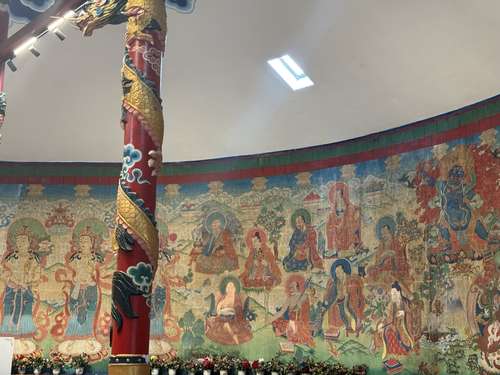
From that moment onward, Tibetan Buddhism flourished across Mongolia. Monasteries were established throughout the steppe, becoming centers of learning, philosophy, medicine, astrology, and art. The religion’s rich ritualism and pantheon of deities inspired intricate sculptures, thangka paintings, temple architecture, and ceremonial objects that remain central to Mongolian cultural heritage.
Suppression in the 20th Century
The 20th century brought profound upheaval. During the Stalinist purges of the 1930s in the Mongolian People’s Republic, religious institutions were systematically destroyed. Monasteries were dismantled, sacred texts burned, and thousands of monks persecuted or executed. Historian Robert Rupen noted that in the 1920s, Mongolia had more than 112,000 monks—over 13% of the population. By the 1940s, nearly all had been killed, imprisoned, or forced to renounce their vows.
This tragic period is depicted in the Mongolian film Moilkhon (A Pearl in the Forest), which reflects on repression and loss. In neighboring Inner Mongolia, religious life was further damaged during China’s Cultural Revolution.
For decades, both Buddhism and shamanism survived only in secrecy or symbolic form.
Revival After 1990
Following Mongolia’s democratic transition in 1990, religious freedom was restored. Monasteries were rebuilt, ceremonies revived, and younger generations began reconnecting with spiritual traditions. While the vast monastic system of earlier centuries has not fully returned, Buddhism once again plays a visible and respected role in public life.
According to Mongolia’s 2010 national census, approximately 53% of the population identifies as Buddhist. Today, monasteries in Ulaanbaatar and across the countryside stand as symbols of cultural resilience and renewal.
The Has Temdeg: A Sacred Symbol
Visitors are sometimes surprised to see swastika-like symbols displayed in temples and decorative motifs. In Mongolia, this ancient sign is known as the has temdeg. Far older than its appropriation by the Nazi regime, it represents eternal movement and cosmic harmony. Its arms revolve symbolically around the North Star—Altan Hadaas (“Golden Nail”)—just as the four seasons turn through the year.
The symbol appears across numerous ancient cultures, including Hindu, Buddhist, and Native American traditions such as the Hopi and Ancestral Puebloans. In Mongolia, it remains a sacred emblem of continuity, balance, and good fortune.
A Living Faith
Mongolian Buddhism is not merely a doctrine—it is a synthesis of sky worship, steppe spirituality, Tibetan philosophy, and historical endurance. Prayer flags flutter across mountain passes, monks chant in restored temples, and ancient symbols continue to guide daily life. Though shaped by persecution and revival, Buddhism in Mongolia remains a living bridge between past and present, earth and sky.

© Copyrigh 2026 Laki Maikaʻi. Tous droits réservés.