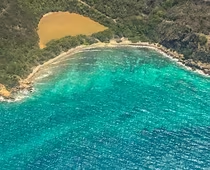
Saint-Croix
Saint-Croix in the US Virgin Islands
Location
St Croix, U.S. Virgin Islands

Our trip to Saint-Croix in the US Virgin Islands was one of the happiest mistakes we've ever made. Let me explain.
We had an opportunity to take a quick trip without the kids. The selection of the US Virgin Islands was an easy choice because it isn't far from the East coats and doesn't require a visa for US citizens. We did some research and booked a hotel on Saint Thomas, the main island, and also found a cute hotel on another island, Saint-Croix, and booked it as well. We booked the flight to Saint-Thomas, a rental car, and the ferry to Saint-Croix....wait, there is no ferry to Saint-Croix? No, the ferry only goes to Saint-John...we booked a nonrefundable hotel on the wrong island.
So we adjusted and booked a plane ticket to Saint-Croix and another rental car there.
The trip

© Copyrigh 2026 Laki Maikaʻi. All rights reserved.
After arriving in Saint-Thomas we took our connecting flight to Saint-Croix. We boarded a tiny twin-propeller plane seating about 10 people including a passenger in the copilot seat and enjoyed about 40 minutes of amazing sceneries and very loud vibrations.
Our stay at Saint-Croix was one of the most memorable trips we have taken. The island is a lot less busy than Saint-Thomas and a perfect relaxing place to enjoy this paradisiac place.
The West Beach, with its white sand and turquoise clear water quickly became our favorite spot to enjoy a morning swim, followed by a relaxing and refreshing beverage at the next door Beach Side Cafe at Sand Castle on the Beach.
The city of Christiansted is also a perfect way to discover the island’s rich history without the crowds. We found some amazing mangoes and nutmeg at the La Reine Farmers' Market and met some amazingly friendly locals.
Driving on the island was a bit challenging at times because cars drive on the left side of the road. ”Keep left” became our motto while driving, especially on small roads with little traffic. An unexpected challenge was actually Google Map directions, which at the time was blissfully unaware of the fact that cars drive on the “wrong” side of the road and kept telling us to make a right turn from the main divided road, which isn’t possible when you are on the left lane and there is a concrete barrier In the way!
The hike at the Jack and Issac Bay Preserve Trailhead was short but quite beautiful. We also had to visit Point Udall, the easternmost point in the United States of America (well...depending on how you measure, but stunning nonetheless!).
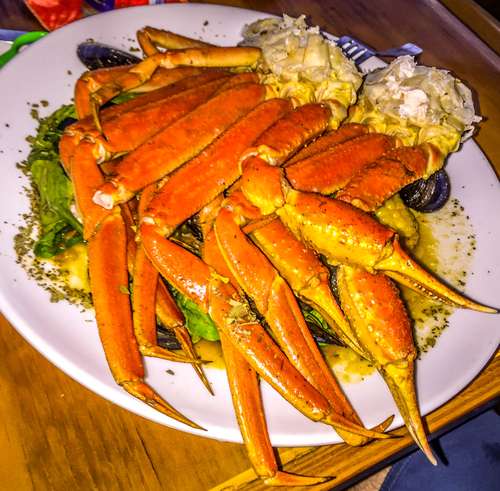
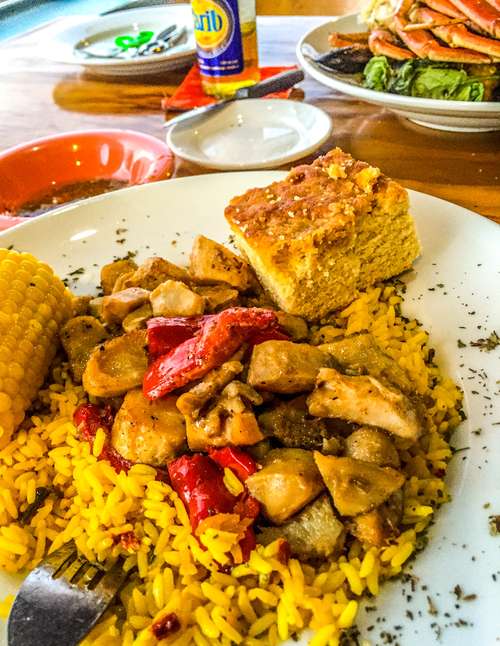
Our dinner at the Blue Water Terrace restaurant was one of the most memorable experiences on the island and remains one of the best seafood meals we’ve ever had. Don’t forget to try the conch, you won’t be disappointed! I had the crab and was served a nice size and deliciously prepared crab. I have to say that cracking so many crab legs was quite a workout, but the beautiful, setting right on the coastline made it more than worth it.

© Copyrigh 2026 Laki Maikaʻi. All rights reserved.
History
St. Croix is the largest of the islands in the territory, but the capital Charlotte Amalie (and the main airport), is located on St. Thomas. The island's highest point is Mount Eagle, at 355 meters (1,165 ft). St. Croix's nickname is "Twin City", for its two towns, Frederiksted on the western end and Christiansted on the northeast part of the island.
Archeological evidence indicates that the island was inhabited by various indigenous groups during its prehistory. Christopher Columbus landed on the island on 14 November 1493, which he called Santa Cruz (Holy Cross). He was immediately was attacked at Cabo de la Flecha (Cape of the Arrow) by the Kalinago, who lived at Salt River on the north shore. This was the first recorded fight between the Spanish and a New World native population. The Spanish didn't colonize the Islands, but most or all of the native population was eventually dispersed or killed. By the end of the 16th century, the islands were said to be uninhabited. The island was claimed/conquered repeatedly by the Dutch, English, French, and Spanish.
On 15 June 1733, it was purchased by the Danish West India Company from Louis XV 750,000 lives and became part of the Danish West Indies. By the mid to late 18th century, "at the peak of the plantation economy, the enslaved population of Saint Croix numbered between 18,000 and 20,000, the white population ranging between 1,500 and 2,000". Future Founding Father Alexander Hamilton grew up in Saint-Croix, before becoming an orphan and later given the opportunity to further his education in New York.
In 1916, Denmark sold Saint Croix, St. Thomas, and St. John to the United States, formalizing the transfer in the Treaty of the Danish West Indies, in exchange for a sum of US$25 million in gold. I guess you really can buy paradise!

© Copyrigh 2026 Laki Maikaʻi. All rights reserved.